Spring flowers

Walter Crane wallpaper, 'Dulce Domum', 1904 - http://collections.vam.ac.uk/item/O225568/wallpaper-dulce-domum/

As the spring finally gets under way and the bluebells and hawthorn are in bloom, it’s a good time of year to think about the importance of flowers in British design. Floral motifs are interesting as they can be both homely and familiar and strange and new. Even without overt symbolism, the choice of flowers can also create meaning, referring us to wild countryside, to planned gardens, or to heated greenhouses. William Morris and Walter Crane understood this, combining British wildflowers in arrangements that drew on medieval ‘mille fleurs’ tapestries but also responded to the taste of their times. This Crane design, with native bluebells, daisies and cranebill, is titled ‘Dulce Domum’ – ‘Home Sweet Home’.

Posted in Uncategorized | Tagged , , , , , , | Leave a comment

Designing Women: Post-War British Textiles

Lucienne Day teatowel, 'Bouquet Garni'


As part of London’s Cultural Olympiad, the Fashion and Textile Museum is presenting an exhibition of 1950s and 1960s textile designs by women. This is an unusual initiative for them on several levels; firstly because most of the designs were intended for interiors rather than for fashion, and secondly becuase while some of the designers are well known, they have not previously been presented as an all-female group. Lucienne Day’s work is the best known, particularly her designs for the 1951 Festival of Britain, and her collaborations with her furniture designer husband Robin. But the work of Jacqueline Groag, Marian Mahler and Paule Vezelay displayed here is equally arresting. Several different approaches to design are in evidence, from  small-scale representational motifs of pepper-pots for kitchens to bold arabesques with repeats of a yard or more to dress picture windows. All are executed with an eye on practical considerations: limited numbers of colours for economy, carefully chosen colour schemes to fit a variety of spaces, patterns that are distinctive without being overwhelming. The exhibition contextualises the lengths of printed fabric with swatches showing alternate colourways, and with contemporary magazines that discuss their potential for readers’ houses. The uses made of new designs, and the basis on which they were or were not chosen by consumers, is an important corrective to some designer-focused exhibitions. In the corridor outside the gallery is a display of linen teatowels designed by Lucienne Day and others, many unused and with the Design Council seal of approval still visible. These were an interesting initiative, a form of ‘diffusion’ design available to consumers who couldn’t affordnew curtains and chairs. One wonders how many of them were kept as a form of textile art.

http://www.ftmlondon.org/exhibitions/detail/?ID=75

Posted in Uncategorized | Tagged , , , , , , , , , , | Leave a comment

The pre-1914 Russian Empire in colour

Between 1905 and 1914 a Russian aristocrat, Sergei Mikhailovich Prokudin-Gorskii travelled through the Russian Empire photographing people and places using a colour process he had invented. When he fled to the USA after 1917 the photographs went with him, and were accessioned by the American Library of Congress. Now digitally restored and available online, they offer an unparalleled glimpse of little-known cultures. They will provide essential information to ethnographers trying to track the evolution of textile practices not only in Russia but in Uzbekistan, the Ukraine, and the Arctic regions. They are also visually stunning, and should inspire a new generation of designers. My favourite is the family of Khivan nomads seated in a yurt that glows with different shades of red fabrics.

Khivan nomads in Russian central Asia c1910

http://www.bbc.co.uk/news/in-pictures-17449958 http://www.loc.gov/pictures/collection/prok/

Posted in Uncategorized | Tagged , , , , | Leave a comment

All Work and Low Pay extended to August 2012

Hammer used by a woman chain maker in Cradley Heath, West Midlands c1900

The exhibition ‘All Work and Low Pay’ at the Women’s Library has been extended to August 2012, with additional tours and events. There has been a lot of media interest and great feedback from visitors. Some visitors have left accounts of their own experiences in the workplace – some of them showing obstacles that persist for women. Read some of their comments and download the information sheets for the exhibition here:

http://allworklowpay.wordpress.com/

Posted in Uncategorized | Leave a comment

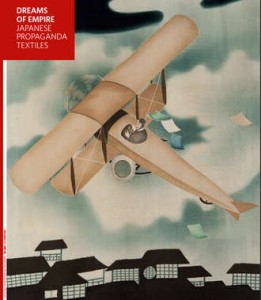
Dreams of Empire – Japanese Propaganda Textiles

Dreams of Empire, Japanese Propaganda Textiles

As part of my information-gathering for the Oxford Bibliography Online of Children’s Clothing I’ve been looking at changing dress-codes for children in Japan. I was put in touch with Dr Barak Kushner at the University of Cambridge, who has written about a fascinating collection of children’s kimonos from 1920s-40s Japan. The Marcuson & Hall Collection has textiles printed with children dressed as soldiers or writing ‘comfort letters’ to the troops, and girls’ kimonos with candy-coloured tanks and military helments. The disconnection with the realities of war is striking, even more noticeable than in the textiles for adults studied by Jacqueline Atkins.

http://www.barakkushner.net/dreams_of_empire_110245.htm

http://marcusonandhall.com/exhibitions/dreams-of-empire

Posted in Uncategorized | Leave a comment

New designs from old at The National Archives

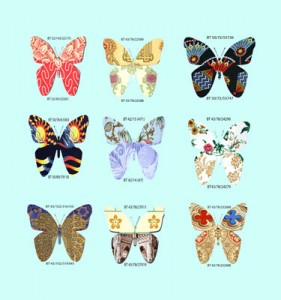
The National Archives hold an incredible wealth of textual documents that are used by historians, and it’s common to find academics poring over medieval court rolls or World War I government records. What is less well known is their visual documents, especially the designs for patents registered after 1842. These cover all imaginable products, from pins to steel smelters and from ribbons to horse blankets. Where possible, samples of the products were preserved along with the patent registration, and bound into bulging leather-clad volumes weighing up to 10kg. The archive is trying to encourage designers to use this resource, and has posted some reinterpretations of historic designs on its website. The butterflies below are labelled with the reference numbers of the original designs – BT standing for Board of Trade.

http://www.nationalarchives.gov.uk/imagelibrary/creative-images-showcase.htm

Butterflies using textile designs from Board of Trade registers, The National Archives

Posted in Uncategorized | Leave a comment

Today Programme interview

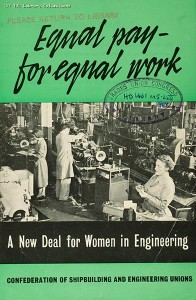
‘A New Deal for Women in Engineering’, 1954
I was interviewed on Radio 4 Today Programme on 2 January (Business News section, 8.40am) about my exhibition ‘All Work and Low Pay’ and its implications for  women in the workplace. What I found most puzzling when researching the exhibition is that in spite of mass participation in the workplace at all levels (7 million in 1951) women workers have always been seen as ‘exceptional’ and a ‘new’ phenomenon. This means that the needs of dual-earner households (especially childcare) are never tackled systematically, and are left for individuals to sort out at their personal cost.  
Posted in Uncategorized | Leave a comment

Burton Constable

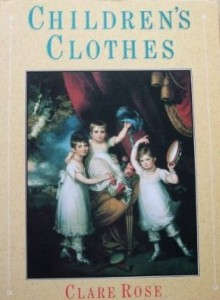
The papers have announced the death of John Chichester-Constable, owner of Burton Constable. I first went there in 1986, when York Castle Museum was asked to lend some toys for a film being made there. As Keeper of Costume (and dolls), I drove out there with the toys and stayed to watch over them. The hall door opened to a scene straight out of Virginia Woolf’s Orlando: grand rooms so cold you could see your breath, in spite of log fires stoked by an elderly retainer, and a general sense of impending decay. Chichester-Constable’s great achievement was to preserve this anachronistic house and its treasures, which included a whale skeleton mentioned in Moby Dick, and a fine collection of family portraits. He kindly allowed me to use a painting of three Clifford children, c1810, on the cover of my book Children’s Clothes Since 1750. Let us hope that his efforts have secured Burton Constable for future generations.

http://www.guardian.co.uk/books/2011/dec/30/john-chichester-constable?INTCMP=SRCH

Posted in Uncategorized | Leave a comment

How New is the New Philanthropy?

In a Radio 4 programme airing on 19th December at 8pm Professor Hugh Cunningham considers the history of philanthropy and charitable endeavours and what we can learn from this today. I’ve been interviewed about my research on the archive of Dr Barnardo’s Homes, where I looked at the thousands of photos of children entering care. These photos showed the children not as ‘waifs’ or street urchins but as members of struggling families; families who were trying to do the best for their children against terrible odds. Most of the children entering Barnardo’s Homes before 1900 were older boys, which makes us wonder what happened to the younger brothers and sisters. From the case histories that have been published, it seems that parents (most often widowed or deserted mothers) would do all they could to keep young children and girls at home or with relatives, and sending older boys somewhere that promised them vocational training. That might be Barnardo’s, the Church of England Children’s Society, or a Naval Training Ship (which took boys  aged 11). A key aim was to keep children out of the ‘workhouse’ – even if parents ended up there. The status of the children is expressed in the clothes they wear in the photos: they enter wearing outfits that may be scruffy, but which are often chosen so that brothers match each other. As they leave Barnardo’s they are photographed in tailored suits, or naval jerseys which indicate they have been educated and are ready for employment. Workhouse boys were rarely photographed, but seem to have been dressed in generic working men’s outfits (often handed-down and badly fitting) and to have been trained only for dead-end labouring jobs. What interests me is that poor families understood the different meanings of these clothes; rather than protesting at the emphasis society placed on ‘respectable’ dress, the photos show that they were doing all they could to make their children look ‘respectable’.

http://www.bbc.co.uk/i/b018b8s5/

Posted in Uncategorized | Leave a comment

All Work and Low Pay Blog online

historic documents and timeline

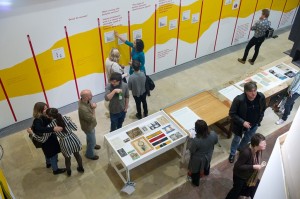
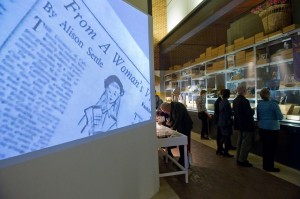
The opening of All Work and Low Pay was a festive occasion, with speeches from Sarah Veale, Head of Equality and Employment Rights at the TUC and Julie Howell, Director of Libraries at London Metropolitan University. We also had some songs by the choir Velvet Fist – tunes I have somewhere on vinyl! The exhibition is hard to photograph as the cases are so big, but these images give a flavour and there is more on the blog. http://allworklowpay.wordpress.com/

tools of the trade display
Posted in Uncategorized | Leave a comment