
I was interviewed on the Today programme on Radio 4 on 4th November as part of a feature marking the centenary of Woman’s Weekly magazine. The publishers have reissued the first ever edition, and it is fascinating; it has articles to appeal to mothers of families and to young ‘working girls’, including careers advice, instructions in home dressmaking, and quick and cheap recipes. The difficulties of women’s lives are hinted at by the advertisements for cures for hernias and for general ‘low health’; these might have been placebos, or based on alcohol, but in 1911 most women couldn’t afford to see a qualified doctor so had to rely on patent medicines. There were many similar magazines in 1911, read by thousands of women who commuted in to work by train or tram, as well as at mothers of families. The most successful responded closely to their readers’ interests. Others aimed to promote a political or moral agenda – like the Suffrage magazines Common Cause and Votes for Women. Sisters magazine, founded in 1895, seems to have been aimed at both middle-class and working women, but sank without trace.
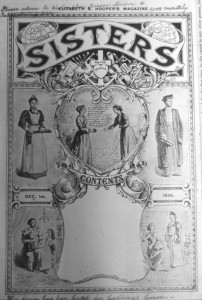
Cover artwork for 'Sisters' magazine, 1895